For the first time, BMW will use humanoid robots for car manufacturing in Europe.
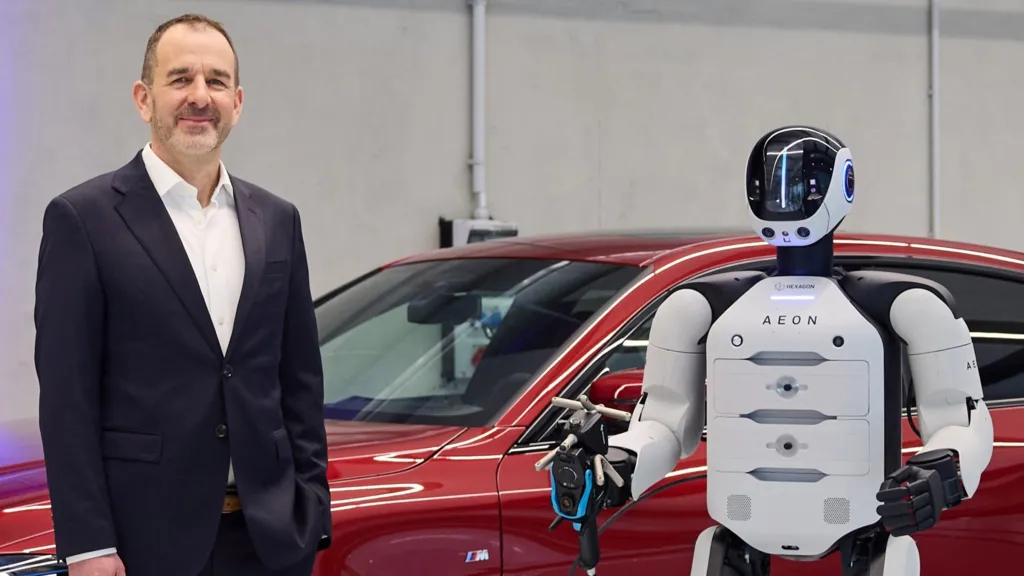
Two robots, made by Hexagon Robotics, are planned to work in production from the summer. They're currently in a test deployment at the Leipzig factory.
"This will be the future of automotive production," says Michael Nikolaides, head of process management and digitalisation at BMW.
Robot arms and other automation have been used by the car industry for decades.
So why the move to human-shaped robots?
"If you have a humanoid form, you can pretty much set it to any workplace where a human is working today because it has the same size and the same capabilities," says Nikolaides.
The cost of robots has fallen while it remains expensive to redesign the assembly line. As a result, it's more cost-effective to use robots that fit in with existing human processes.
"When a robot costs 17 million, you'd re-organise your factory around the robot, but it doesn't anymore," says Bill Ray, distinguished VP analyst at Gartner.
"So now you want to fit it into your existing way of working."
Named Aeon, the Hexagon robot is shaped like a person and stands 1.65m (5ft 5in) tall, weighing 60kg (9 stone 6lbs).
They have a top speed of 2.4m/second and can carry 15kg for short periods, or 8kg continuously.
Aeon is equipped with 21 sensors including cameras, radar, a microphone, and force and torque sensors for manipulation.
At BMW the robots were trained using a combination of teleoperation (sensors on humans) and simulation in a digital twin of the factory using software from Nvidia.
The training of robots is undergoing rapid development - the quicker you can train a robot the better.
One of the most exciting aspects of the application of AI to the physical world (physical AI) is imitation learning, according to Arnaud Robert, the president of robotics at Hexagon.
That is where the robot learns how to do a task by looking at how the task is done, either using videos from multiple angles or movement sensors on the human. Robert says imitation learning can cut the time taken to train the robot from months to days.
"The best translation [from the human to the robot] is when the teacher and the student have the same form factor."
So, could the robot just watch someone packing boxes for a bit and then join in?
"That's the ultimate scenario," says Robert. "You're describing probably something that's a year or two out."
Ray at Gartner estimates that within three to five years a robot will be able to take simple voice instructions to carry out a task effectively.
Aeon only has a battery life of three hours, but a shift lasts for eight hours, so the robot has been designed to swap its own battery in about three minutes, including travelling to and from the charging station.
The robot in the simulation was given a task and repeatedly simulated it to identify the most promising solutions, an approach called reinforcement learning.
Teleoperation was used for tasks such as picking up a part, so the physical robot could learn the range of different ways a human carries that out.